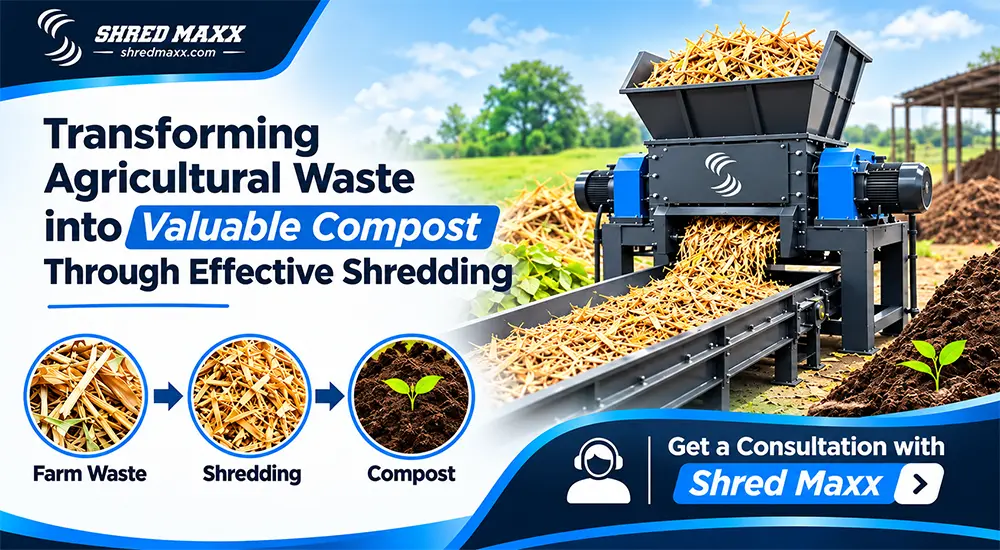
Farms produce a lot of organic waste. This includes stalks, dry leaves, husks, vegetable waste and small twigs. Leaving the organic matter can cause loss of the valuable nutrients. Burning also can cause issues with smoke affecting surrounding communities.
The composting process begins with good preparation. Shredding makes large pieces of waste easier to manage by breaking them down into smaller pieces. For farms looking for Organic Waste Shredder Machine Manufacturers in India, the appropriate equipment begins with identifying the waste stream.
Microorganisms have less surface area to decompose large stalks, fibrous stems and branches. These shred them into smaller pieces to increase the surface area, and therefore mixing with other softer waste like leaves, grass clippings, vegetable scraps.
Smaller pieces are more easily moved and distributed over a composting area. They can also decrease manual handling and enable workers to create more even piles. But reducing material to powder should not be done without taking into account the composting process. The particle size is suitable so that air will be able to flow through the pile and microorganisms will have a sufficient area available.
Each farm has its own residue. Suitable feedstock can be dry crop stalks, leaves, plant trimmings, husks and specific organic processing waste. Equipment may be required for the size and strength of woody branches or tough fibrous materials.
Remove stones, metal objects, plastic string and other foreign objects before processing. These pollutants can lead to the harm of cutting components or to affect the quality of composts. Verify the machine is appropriate for the use of the feedstock.
When looking for Organic Waste Shredder Machine Manufacturers in India, businesses require a dependable method to process significant quantities of organic waste. The incoming material needs to be shredded to a size to which the other compost ingredients can be mixed and to move around the site.
For Shred Maxx, however, the emphasis is placed on providing shredding and waste processing solutions for various applications. When choosing the suitable equipment for agricultural waste, the following should be considered: nature of the residue, the expected throughput per hour, the size of output material, space limitations, and how the shredded material will be handled. Choosing the right machine is more important than looking for the one with powerful engine.
First, classify the residue and clean off the residue from the inorganic components. Then, shred the organic material and mix it with other components to balance carbon and nitrogen content.
The next stage is making the compost heap or using a composting system as necessary. It is essential that the moisture content of the compost pile be approximately the same as that of a wrung-out sponge. There should be oxygen in the compost pile, and turning of the compost pile will help in reducing any odors. The temperature and moisture levels of the compost pile should be monitored.
Therefore, before you even get to the Organic Waste Shredder Machine Manufacturers in India, make sure that you have listed the material types and their volumes. Discuss feed opening, cutting system, throughput, maintenance access, safety features and anticipated production for the material.
Schedule for regular inspection and safe operation. Keep the machine clean and maintained in accordance with the instructions from the manufacturer, and avoid putting your hands inside the machine while it is running.
Efficient shredding turns large farm wastes into easily processed compost feed. When mixed, moistened and aerated correctly, it provides a convenient way to use farm waste as a beneficial soil amendment. Shred Maxx can assist businesses in examining their choices depending on the materials and processing requirements. The right choice begins with understanding your waste stream and composting process.
Get a consultation with Shred Maxx and discuss your organic waste processing needs, and find the ideal shredding solution.
Shredding helps to break up large residue items and to increase uniformity and ease of handling and decomposition.
Depending on machine specifications, leaves, crop stalks, plant trimmings and selected organic residues could be appropriate.
Take into account the material type, the number of pieces per day, the output size, safety features, maintenance requirements, and manufacturer's instructions.