If your facility is still treating waste management as an afterthought—or worse, relying on outdated single-shaft systems for heavy-duty throughput—you’re burning through margins and missing a massive compliance beat.
When we talk about achieving true circular economy metrics, the heavy lifting doesn't happen in a boardroom. It happens on the factory floor. That is exactly where industrial double shaft shredders for waste come into play.
At Shred Max, we engineer these machines not just as raw hardware, but as the literal backbone of modern, eco-conscious industrial processing. Here is the unfiltered breakdown of why dual-shaft technology is no longer optional for sustainable operations.
In my decades of analysing material-processing setups, the single biggest mistake I see plant managers make is misjudging material resistance. A single-shaft shredder relies on high speed and a pusher ram. It’s great for uniform, light materials like paper or small plastics. But mixed industrial waste? It’s unpredictable, bulky, and completely unforgiving.
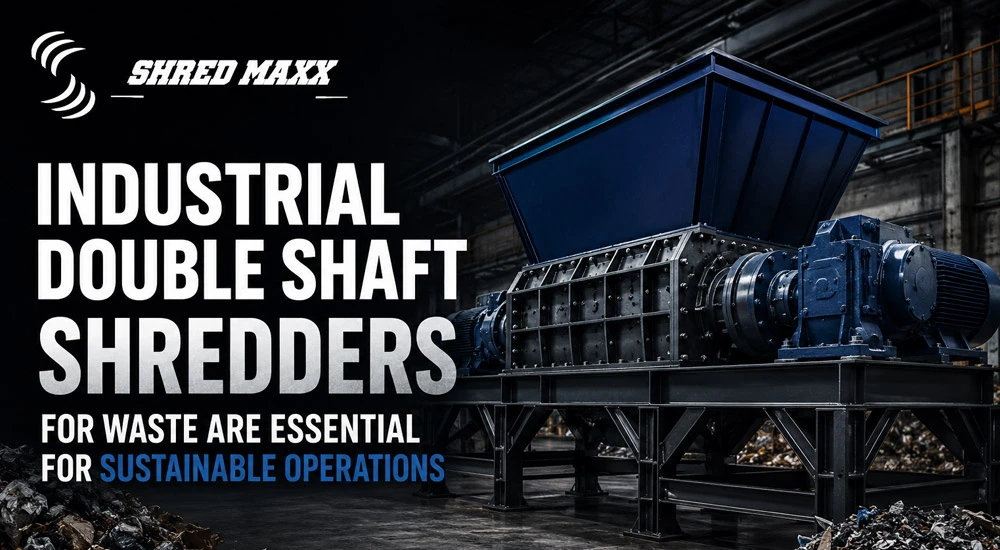
Industrial double-shaft shredders for waste operate on a completely different mechanical principle: high torque at low speed.
Instead of trying to smash through material with raw velocity, two parallel shafts, each equipped with heavy-duty cutting discs, rotate inward toward each other. This hook-and-shear action grabs the waste material and pulls it through the blades, tearing it apart effortlessly.
The low-speed design means the machine uses energy far more efficiently. By slicing through high-volume waste streams without constant jams, you maintain a continuous operational rhythm while drastically reducing energy spikes. Furthermore, if the machine encounters an un-shreddable object, smart automated control systems reverse the shaft direction to clear the jam, preventing catastrophic mechanical failure and costly downtime.
A truly sustainable operation cannot afford to segregate waste streams into dozens of tiny sub-categories just to accommodate fragile equipment. You need a workhorse that swallows whatever you feed it.
Dual-shaft shredding systems excel at processing high-resistance materials that would easily choke or damage standard equipment. We are talking about:
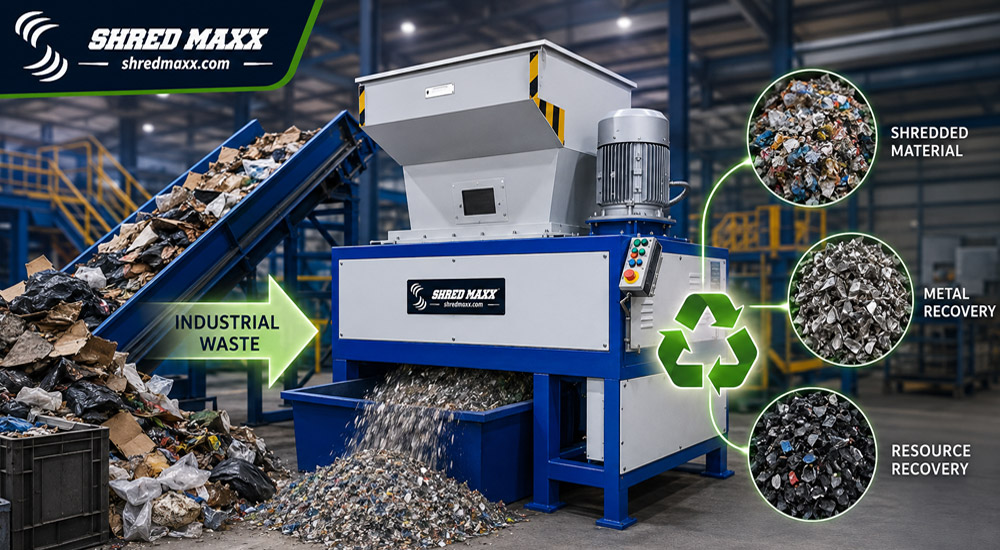
By reducing these varied, high-volume materials into uniform, manageable fractions, you immediately optimize your downstream sorting, recycling, or energy-recovery processes.
Let’s talk numbers. Sustainability has to make financial sense, or the C-suite isn't going to approve the capital expenditure. Implementing a Shred Max dual-shaft system hits your bottom line positively in three distinct areas:
Transportation is one of the quietest carbon and budget killers in industrial logistics. Hauling loose, bulky waste means you are paying premium rates just to transport air. Our heavy-duty shredders achieve up to a 70% to 80% volume reduction. That translates directly to fewer trucks on the road, lower fuel consumption, and heavily slashed tipping fees at disposal sites.
You cannot recycle what you cannot isolate and handle. Whether you are prepping plastics for clean pelletization or isolating valuable metals from complex e-waste, uniform particle size is mandatory. The precise shearing action of a double-shaft system creates a consistent output size, turning raw waste into valuable, market-ready secondary raw materials.
For materials that genuinely cannot be mechanically recycled, Refuse-Derived Fuel (RDF) is the sustainable alternative. Dual-shaft shredders process municipal and industrial waste into the exact uniform sizes required by RDF boilers, ensuring efficient combustion with minimal emissions.
Look, I’ve seen plenty of cheap imports flood the market over my career. They look shiny in the brochure, but they crack under real-world industrial stress within eighteen months.
At Shred Max, we don't build machines to hit a budget price point; we build them to survive decades of brutal operation. Our dual-shaft shredders feature proprietary, high-alloy steel blades designed for maximum wear resistance and easy maintenance. We couple this with high-efficiency motors that deliver maximum torque with a surprisingly low energy footprint. When you invest in a Shred Max, you are investing in a closed-loop future for your business.
It's all about torque and material handling. Single-shaft shredders operate at high speeds and are suitable for fine, consistent particle sizes for soft materials. In contrast, Industrial double shaft shredders for waste run at lower speeds and high torque levels, efficiently shred large volumes of more complex, tough materials such as metals, tyres and thick plastics without jamming or significant blade wear.
The life of the blades is dependent on the abrasiveness of your waste stream. An abrasive e-waste or metal scraps will have a much shorter blade life than processing clean plastics. Made of high-quality surface-treated alloy steels and a modular design of blades, the Shred Max systems enable you to sharpen or replace individual blades, thus reducing your maintenance costs in the long run.
Yes. Our double-shaft shredders run at a slower RPM (rotations per minute), therefore have less heat, friction and dust than high-speed shredders. The processing speed is slow which significantly lowers the chances of sparks forming in the process, and is the standard solution for handling hazardous, medical or potentially volatile industrial waste streams safely.
In this era of industry, it is a definite “must” to pay attention to your waste footprint. Making the switch to a sustainable operation isn't only about regulation, it's about optimizing your logistics, regaining value and securing the future of your brand.
The best way to get there is to incorporate industrial double-shaft shredders for waste into your facility. A high-torque Shred Max system powers your processing line, turning your waste management from a cost and time-constrained headache into a high-performance, environmentally friendly asset. Looking to maximize your throughput? Let's discuss how to customize a shredding solution for your operations today.